Lighting Design for HDB and Condo Homes: Layering Light Like a Designer
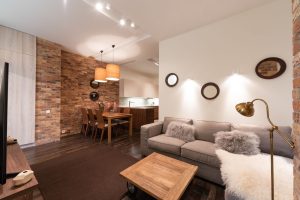
Walk into most freshly handed-over flats at night and you’ll see the same thing: one bright ceiling light per room, switched on full, flattening everything into a hospital glow. It does the job. It also makes a beautiful renovation look ordinary the moment the sun goes down.
Good home lighting design Singapore homes can actually live with has little to do with how many fixtures you cram into the ceiling. What matters is layers, and being clear about what each light is for. At Reno Bros we plan this before the false ceiling goes up, because once the trunking and gypsum are in, moving a downlight means cutting and patching. Get it right on paper and the room does the work for you.
The single-ceiling-light mistake (and why layering fixes it)
One central light throws everything flat. No shadow, no focus, no warmth. Your sofa, your feature wall, your dining table all get the same wash, so nothing stands out.
Designers solve this with three layers working together:
- Ambient. The base wash that lets you move around safely. Recessed downlights, cove lighting tucked into a false ceiling, the occasional ceiling pendant.
- Task. Light aimed at where you actually do things. Under-cabinet strips over the kitchen counter, a vanity light beside (not above) the bathroom mirror, a reading lamp by the bed.
- Accent. The mood maker. A wall-wash grazing a fluted feature panel, pendants over the dining table, a picture light on art.
You rarely run all three at once. The point is having the option. Movie night runs on cove plus one lamp. Cooking runs on bright task light over the hob. Same room, completely different feel, controlled by how you split the circuits.
Get the colour temperature right, or none of it matters
This is the decision people regret most, because warm and cool light in the same open-plan HDB living-dining zone looks like a mistake even when every fixture is expensive.
Rough rules that hold up in Singapore homes:
- Living room and bedrooms: 2700K–3000K. Warm, easy on the eyes at night, kinder to skin tones.
- Kitchen and study: 4000K. Neutral white makes raw chicken look like raw chicken and helps when you’re chopping or reading.
- Corridors, service yard, bomb shelter: 3000K–4000K, whatever blends with the rooms either side.
The trap is mixing temperatures on the same ceiling plane. In a typical 4-room flat where living and dining share one continuous ceiling, keep that whole run at one temperature, usually 3000K, and let the kitchen step cooler behind a wall or transition. Want flexibility? Spec tri-colour or tunable downlights so you can switch 3000K/4000K per scene. Just don’t scatter random temperatures and hope they read as intentional. They won’t.
What the layers actually cost
Lighting is one of the better-value lines in a renovation, which is why it’s frustrating to see it done lazily. Real ballpark figures as of 2026, and these move with brand and ceiling complexity:
- Downlight installation: typically SGD 60–100 per point for cutting the false ceiling, wiring and fitting. The fixture itself runs from about SGD 6 for a basic LED up past SGD 200 for premium adjustable gimbals.
- Cove / LED strip lighting: a perimeter cove in a 4-room living room needs roughly 10–15 metres of strip; pelmet and strip work often lands around SGD 130–450 per room depending on size. Spend on a decent COB strip, because the dotty older strips show every LED through the diffuser.
- Whole-flat lighting fixtures: downlights, pendants and decorative pieces together commonly total SGD 800–2,000 for a full HDB, before you go designer-pendant shopping.
For context, that’s a small fraction of a full-home reno often sitting in the SGD 45,000–70,000 band for a 5-room. Lighting punches well above its cost, which is exactly why it deserves more than a last-minute call.
Plan the wiring before the walls close
The expensive mistakes in lighting are never the bulbs. They’re the things you can’t change later without hacking. This is just as true in a condo fit-out, where MCST rules and a fixed handover date leave even less room to redo work.
Think this through while the walls are still open and the false ceiling isn’t boarded:
- Split your circuits. Separate switches for downlights, cove and accent so you can dial scenes. One switch for everything defeats the whole exercise.
- Run a neutral wire to switch points if you might add smart switches. Retrofitting smart switches is far easier when the neutral is already there.
- Decide dimmers early. Dimmable cove in the living room is the single best comfort upgrade. The driver and switch must both support it.
- Mark switch heights and positions on a walk-through, not on a plan you’ve never stood inside. Standing in the room and miming where your hand reaches beats guessing on paper.
One genuinely useful thing we’ve learned doing handovers: tape the planned downlight positions onto the bare ceiling slab before fabrication and stand under them in the evening. People always shift two or three once they see them in the actual room. Far cheaper than re-cutting gypsum after the fact.
Now the compliance bit, which isn’t negotiable. All electrical work tying into your HDB or condo supply must be carried out or supervised by an EMA-Licensed Electrical Worker; for a standard HDB flat, an electrician-class LEW is sufficient, and you can verify any licence through EMA’s online LEW search. For HDB flats, note that certain electrical alterations also have to be declared to or approved by HDB, and your contractor or LEW handles that submission.
The hours matter too, and people get these wrong. Noisy works (heavy drilling, hacking, demolition, removing wall or floor finishes) are restricted to 9am to 5pm on weekdays only (Monday to Friday), and are not permitted on Saturdays, Sundays, public holidays, or the eve of a major public holiday. General, quieter renovation, including most wiring, is allowed 9am to 6pm Monday to Saturday, with nothing on Sundays or public holidays. Cove and downlight fitting itself is quiet, but any associated chasing, hacking or heavy drilling falls under the stricter noisy-works window.
Frequently asked questions
Do I need a false ceiling to get cove lighting?
Usually yes for a clean recessed cove, since the strip hides behind a lip. But there are HDB-friendly perimeter pelmet and surface channel options that give a similar wash without dropping the whole ceiling, which matters when your HDB ceiling is already only around 2.6m. A partial perimeter cove keeps more height than a full boxed ceiling.
Are downlights or track lights better?
Downlights for clean, built-in ambient light you don’t want to notice. Track lights when you want to aim and re-aim — renters, gallery-style walls, or anyone who rearranges furniture often. Many homes use both: downlights for the base, a short track over a feature wall.
Is smart lighting worth it, or just a gimmick?
Worth it if you wire for it. Smart switches that control your existing circuits give you scenes, dimming and scheduling without changing a single bulb, and they survive when you swap fixtures later. Smart bulbs everywhere is the overspend, because you lose control the moment someone uses the wall switch. Get the neutral wire run now and decide the rest later.
How many downlights does a 4-room living room need?
There’s no fixed number, but spacing matters more than count — evenly spaced points with overlapping pools beat a few bright ones casting hard shadows. A typical living-dining run might use eight to twelve depending on layout, paired with cove for fill. We’d rather use more lower-output points than a few glaring ones.
Where lighting earns its keep
Good lighting design for Singapore homes is the cheapest way to make a renovation feel finished, and the easiest thing to botch when it’s an afterthought. Plan the circuits, fix the colour temperatures, and the same flat reads warm and considered instead of flat and bright. If you’d like a lighting plan built properly into the job, take a look at our past projects, see the full range of renovation services, or contact the team. You can also message Reno Bros on WhatsApp and we’ll talk through your layout.
Related Reads
- Condo Renovation Guide: Rules, Timelines and Design Wins
- Ideas for 4-Room HDB Flats That Feel Bigger
- Kitchen Design Guide for HDB and Condo Homes